Introduction |
The Origins of Kimchi |
The value of Kimchi |
Types of Kimchi |
Making Kimchi |
Storing Kimchi |
Conclusion |
Reference |
Discover Kimchi
(Sun Ja's page)
Top
Introduction
Most countries around the world have their own special foods. Kimchi is the most famous Korean food. It takes a role for Korea what Scotch did for Scotland, and what pizza did for Italy.
Kimchi has been maintaining its taste since the founding of Korea, and has becoming more popular in Asia as well as in many other countries.
I want to introduce the origins of kimchi, the value of kimchi, types of kimchi, making kimchi, and storing kimchi to people who have or have not tried Korean dish.
Top
The Origins of Kimchi
Origins of Kimchi (1999), explains the beginning of Kimchi like this :
"The word kimchi has 2 possible origins. Some people believe that it evolved from the native Korean words ji or jimchae (meaning vegetables soaked in salted water), then later changed its pronunciation to timchae or dimchae, then to jimchi, and finally kimchi . Another possible origin is as a Korean pronunciation of the Chinese character Ham-tse or Kam-tse(meaning processed with salted water or pickle vegetables)".
Many Koreans made kimchi to preserve the vitamins and minerals in vegetables for the long, cold winters.
Top
The Value of Kimchi
Kimchi nutrition
Kimchi contains many healthy ingredients as explained below:
"Kimchi has played a role as an important source of nutrients in fermented vegetables during the long winter months. It has different kinds of nutrients based on materials and the level of fermentation. Usually, the materials used in making kimchi have few calories and low levels of sugar, but contain high amounts of fibers, diverse vitamins (especially vitamins A and C), and minerals (such as calcium and iron). The nutrients produced during fermentation (lactic acid bacteria and acetic acid) help protect against cancer and germs"(Kimch'i Nutrition,1999).
These nutrient help directly or indirectly activate a various immune mechanism easily deteriorated in people's diets focusing on meats and grains, and as the lactic acid fermentation vegetables, they become known to promote digestion, and prevent a colon cancer, arteriosclerosis, anemia, and geriatric diseases.
Today many nutritionists over the world, accordingly, regard Kimchi as a food for the future.(material.htm ).
Kimchi in Korean Society
As the kimjang(the name of Kimchi making) season approaches every year.
Many Korean companies even give "kimjang bonuses" to their employees in November to alleviate their financial burdens.
The preparation of kimchi requires many hands, so their neighbors usually help each other.
As an act of friendship, housewives often exchange bowls of kimchi. In doing so, they give their friends a taste of their own unique traditional recipes, which have been handed down from generation to generation.
Through Kimjang, people have a opportunity to know their neighbors well, and improve relationship(Lee,2000).
Top
Types of Kimchi
Types of kimchi differ from region to region, depending on harvest and weather conditions. Each family also has its own recipe handed down from generation to generation.
The number of specific kimchi types can not be easily counted. However, the Korean Food Academy has categorized over 100 different types.
The flavor depends on ingredients, condiments, the amount of salt, and level of spice used in each region. Korea's various regions produce different types of agricultural products, and this is reflected in each region's type of kimchi.
The southern provinces (North and South Cholla Provinces and North and South Kyongsang Provinces) tend to use more salt and seafood so the taste is stronger and sweeter. To the north, kimchi tastes less salty and is very mild,so It is impossible to introduce all kinds of Kimchi( Types of Kimchi ,1999).
Here are some kind:
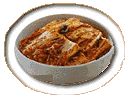
Whole Cabbage kimch'i (T'ongbaech'u Kimch'i)
Each cabbage is cut lengthwise into two sections and soaked in brine. It is then drained, seasoned between the leaves, and left to ferment. This is the classic kimch'i, which you will find on every Korean dinner table. The saltiness differs by regional preference.
Image Copyright 1999 (www.marimari.com). Used with permission.
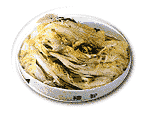
White Cabbage Kimch'i (Paek Kimch'i)
The white cabbage kimch'i, made in the southern part of the republican nation, is less watery than other types of kimch'i. It also contains more pickled fish and red pepper than those made in the northern part.
Image Copyright 1999 (www.marimari.com). Used with permission.
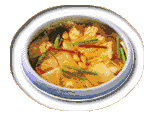
Water Kimch'i (Nabak Kimch'i)
Made of thinly sliced radish, cabbage, watercress, and green onion, this kimch'i is favored at all seasons. Whole green peppers or red peppers are used to give it a mild taste. It is best served chilled.
Types of Kimchi
Image Copyright 1999 (www.marimari.com). Used with permission.
*Whole Cabbage Kimch'i (T'ongbaech'u Kimch'i)
*Wrapped Kimch'i (Possam Kimch'i)
*White Cabbage Kimch'i (Paek Kimch'i)
*Stuffed Cucumber Kimch'i (Oisobagi)
*Hot Radish Kimch'i (Kkaktugi)
*Whole Radish Kimch'i (Ch'onggak Kimch'i)
*Radish Water Kimch'i (Tongch'imi)
*Water Kimch'i (Nabak Kimch'i)
typesofkimchi(1998)
Top
Making Kimchi
Kimjang (Kimchi-making) usually started in late October or early November and lasted for two or three days with help from many people. The number of cabbages prepared depended on the number of household members, usually between 100 and 200 cabbages.
Considering the number of cabbages and amount of preparation for Kimjang, it was not a job for just 1 or 2 people. People considered it as a major annual event, so close relatives, several neighbor housewives, and a few strong men all pitched in and worked together
People who participated in Kimjang helped wash cabbages, prepared materials, and stuffed ingredients inside each cabbage leaf(making Kimchi,1999).
This materials and recipe is the simplest and easiest one
Ingredients
5 cabbages, 2 radishes, 5 cloves of garlics, 5 cups of thick salt, 4 green onions, 1 bundle of dropwort. 3 ginger roots, 300g of mustard leaves, 1/2 cup of fish paste, 2 cups of red chili pepper, 1 cup of sticky rice paste, 2 cups of sugar, 2 cups of oysters
Recipe
1. After cleaning the cabbages, cut them into 2 or 4 pieces.
2. Prepare salted water with a ratio of 2.5 cups of salt to 10 cups of water, then soak the cabbages in it for 6-8 hours.
3. Rinse the soaked cabbages in running water 3 times and then wait for them to dry a bit.
4. Cut dropwort, green onions, and radishes into lengths of 5 cm, then chop the garlic and ginger.
5. Prepare fish paste and add red chili pepper to it with sticky rice paste.
6. Wash oysters in salt water.
7. Mix the ingredients from steps 4, 5, and 6.
8. Put the mixture inside of each leaf then store in a kimchi pot. On the top, cover cabbage with a leaf and sprinkle some salt. Then place a heavy stone on top to compress it
(making Kimchi,1999).
Top
Storing Kimchi
Long before the age of refrigerators, Koreans thought up ways to keep kimchi at a relatively stable temperature in order to eat it for a long time.
In the summer, they put the kimchi jar in a well or a stream, and in winter they buried the jar in the ground, covering it with a bundle of straw to protect it from snow and rain and to lessen the temperature change.
People made a storehouse for kimchi in the backyard with logs arranged like tepees and rice straw put over it, resembling a dugout mud hut.
Nowadays, it is much more popular to store kimchi in refrigerators than in jars in storage place. Many Korean refrigerators are equipped with space reserved for kimchi. (Lee , 1999).
Top
Conclusion
Top
As you can see from my paper, kimchi has abundant nutrition and has contributed to community. kimchi is the most important component of Korea meal.Therefore, it is nature that Koreans can not live without kimchi.
Reference
Lifein in Korea.(1999).Origins of Kimchi.[Online]. Available:
http://lifeinkorea.com/culture/kimchi/kimchi.cfm?xURL=origin (2001,April l0)
Lifein in Korea.(1999).Kimchi Nutrition.[Online]. Available:
http://lifeinkorea.com/culture/kimchi/kimchi.cfm?xURL=nutrition (2001.April 10)
evecvalley.material.[Online]. Available:
http://www.kimchipia.com/english/material/material.htm (2001,April 13)
Jie Hyun lee.(2000.5.31).Kimchi in Korean society.[Online]. Available:
http://www.sogang.ac.kr/~burns/cult96/s950118.html (2001,April 16)
Lifein in Korea.(1999).Types of Kimchi.[Online]. Available:
http://lifeinkorea.com/culture/kimchi/kimchi.cfm?xURL=types (2001,April 10)
Marimari.(1999).Kimchi.[Online]. Available:
http://www.marimari.com/content/korea/best_of/kimchi/kimchi.html (2001,April 13)
Koreantown. (1998).types of Kimchi.[Online]. Available:
http://home.koreantown.com/discover/koreanfood/typesofkimchi.htm (2001,April 16)
Lifein Korea.(1999).Making Kimchi.[Online]. available:
http://lifeinkorea.com/culture/kimchi/kimchi.cfm?xURL=making (2001,April 10)
C.J, Lee (1999). The book of kimchi. Seoul: Korean Overseas Culture and Information Service.
igoodfriend@hotmail.com E-mail to joe sndrus( ??????@yahoo.com)
"what's your first reaction about Kimchi"(2001,April 16)
Image Copyright 1999 (www.marimari.com). Used with permission
http://www.marimari.com/content/korea/best_of/kimchi/kimchi.html ( 2001,April 10)
Top
igoodfriend@hotmail.com
Background graphic created with Grsites
First created: April 3, 2001 / Last updated: April 26, 2001
content
http://www.eslnetworld.com/class/hwang/Kimchi.html